Why Frost Returns at Busy Frozen-Food Transfer Openings?
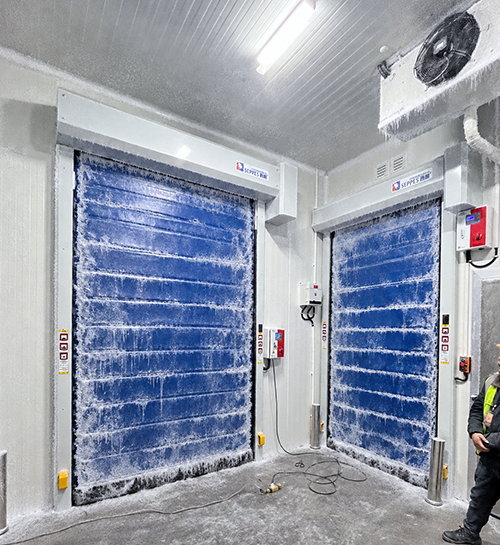
Frost that returns soon after cleaning is a useful warning at a frozen-food transfer opening. The industrial freezer door may have a damaged seal, an excessively long open cycle, or a guide-heating fault. However, moisture may also arrive from a humid staging area or an unsuitable airflow pattern. Replacing the door without identifying the source can leave the underlying problem unresolved.
Frost can interrupt guide movement and complicate traffic. Connect its location with normal shift activity before selecting a remedy.
Why Moisture Collects Around the Opening?
When warmer, moisture-bearing air reaches sufficiently cold surfaces, water can condense and freeze or deposit directly as frost. Frequent transfers repeatedly expose the doorway to that air. The room temperature displayed on a controller does not explain the whole event: humidity outside the freezer, pressure differences, and exposure time also matter.
Map the deposits. Frost near curtain damage suggests checking for leaks; deposits along a guide warrant inspection of seals and heating. Cleaning water or wet loads may contribute. These observations guide investigation without proving a single cause.
Measure the Entire Passage Cycle
During peak replenishment, record activation, waiting, load clearance, and closing times. Cross traffic may trigger a sensor unnecessarily, or a long delay may keep the curtain raised between trips. Adjust settings while preserving safe clearance time.
In its cold-chain automation report, Lineage explains that pallet-only openings can reduce heat entry compared with forklift-sized openings. Review the actual transfer envelope. This reference implies no relationship with SEPPES.
What an Industrial Freezer Door Can Address?
A suitable door works on three separate issues: heat transfer through the closed barrier, leakage around its edges, and exposure during movement. Insulated cold room doors address the first issue through their construction, but performance also depends on fitting, seals, and use. A thick curtain cannot compensate for an opening left raised throughout a picking wave.
For frequent sub-zero transfers, SEPPES offers the Snow Shield double-shaft zipper cold storage doors. Its catalogue describes synchronized dual-shaft drive, a multilayer insulated curtain, zipper-sealed tracks, and heated guides. These features are intended to combine frequent access with insulation and resistance to frost-related guide problems.
The catalogue describes this specific version for applications down to -40 C and opening speeds up to 1.5 m/s. These are configuration references requiring confirmation against the opening size, temperature conditions, and duty. They must not be applied automatically to every Snow Shield variant or treated as a promise of a frost-free doorway.
Heated Tracks Have a Defined Job
Guide heating helps protect the local running path. It does not dehumidify the staging area, remove all incoming moisture, or replace refrigeration engineering. Ask SEPPES to confirm heater coverage, electrical requirements, control behavior, and inspection access. Persistent frost may require coordinated changes to humidity management, pressure balance, cleaning, or traffic scheduling.
Procurement Checks Before Replacing the Door
Give the supplier temperatures on both sides, typical and peak humidity, clear opening dimensions, and photos of the frost before removal. Include operating hours, cycles during the busiest hour, vehicle and load dimensions, and the time spent open. Record nearby evaporators, air outlets, and cleaning practices that may influence the doorway.
For a commercial freezer door quotation, confirm:
- The minimum service temperature for the complete quoted assembly.
- Curtain construction, edge sealing, heater layout, and available power.
- Headroom, side clearances, fixing structure, and maintenance access.
- Activation method, obstruction protection, emergency operation, and fault indication.
- Replacement seals, curtain service requirements, and local support arrangements.
Avoid specifying high speed freezer doors by speed alone. A setting appropriate for one approach may be unsuitable for another. Detection and protective devices must suit low loads, pedestrians, and the operating environment. Commission the opening with representative traffic and verify that the cold conditions do not prevent reliable detection or movement.