What Is a Spiral Door? How It Works and Where It Fits
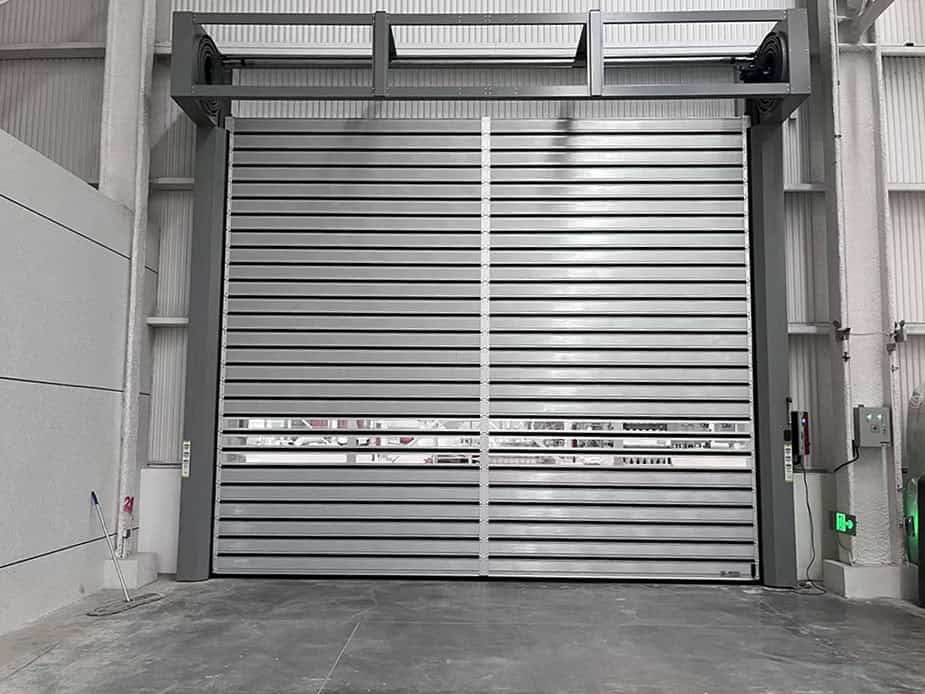
A spiral door is a high-speed rigid industrial door whose connected metal panels travel upward into a non-contact spiral track. Unlike a flexible fabric door, it uses solid insulated panels; unlike many sectional doors, the panel faces do not normally rub together inside the spiral. The design combines rapid cycling with wind resistance, insulation, security, and a rigid exterior appearance.
Here, spiral door means an industrial high speed spiral door, not a game-related or decorative door. It fits busy factory and logistics entrances where a basic roll-up curtain lacks rigidity or thermal separation.
How Does a Spiral Door Work?
Hinged aluminium panels rise through side guides. Above the opening, the guide directs them around a circular or elliptical spiral without winding them tightly onto a drum. Separated panel faces can reduce contact wear and noise. During closing, perimeter seals limit drafts and the insulated core slows heat transfer. Track geometry may change for the available headroom and structure.
Main Components of a High Speed Spiral Door
A complete spiral high speed door system includes insulated panels, hinges, guides, spiral tracks, a drive, controls, position sensing, seals, and safety devices. Buttons, remotes, radar, loops, access control, or automation signals can activate it.
The SEPPES Sonic configuration uses double aluminium skins and a polyurethane core. Catalogue data describes 0.7 mm skins and a 40 mm panel; the related internal sheet also records 50 mm and 80 mm variants. Confirm the selected construction instead of assuming one brochure value applies universally.
Why Choose a Spiral Door Instead of a Standard Door?
A roll shutter is compact and economical but generally slower and less insulating. A sectional door offers rigid insulated panels but is not normally designed for the same traffic speed. Flexible high speed doors cycle quickly but provide less rigid exterior protection.
A spiral overhead door combines an insulated metal barrier with high-speed movement. Shorter exposure can reduce vehicle waiting and uncontrolled air exchange. The U.S. Department of Energy notes that air sealing supports lower heating and cooling demand and improved indoor control, although results depend on the entire opening, seals, controls, traffic, and building envelope.
Typical Applications
Spiral doors suit automotive plants, equipment factories, vehicle service buildings, high-value warehouses, and temperature-controlled workshops when an exterior opening needs speed, wind resistance, insulation, and security.
They are not the answer to every opening. An interior partition may need only a PVC rapid door; a very wide, wind-exposed opening may suit a stacking door; low-frequency traffic may justify a sectional or rolling shutter door. Select by operating problem, not product prestige.
SEPPES Sonic Spiral Door Performance
SEPPES positions Sonic for premium exterior access. Its catalogue lists about 0.8-1.5 m/s for one overview and 1.5-2.0 m/s for a turbine version. The internal turbine sheet gives 0.6-2.5 m/s, a typical 800-cycle daily reference, and wind resistance Level 11. These different configurations must not be merged into one guarantee.
Safety options include infrared detection, a sensing edge, light curtains, and people-vehicle separation radar. Manual release supports emergency opening. Select and test each device around actual vehicles, pedestrians, approach angles, and closing risks.