
Machine Safety Roll Up Door for AI Vision Inspection Equipment
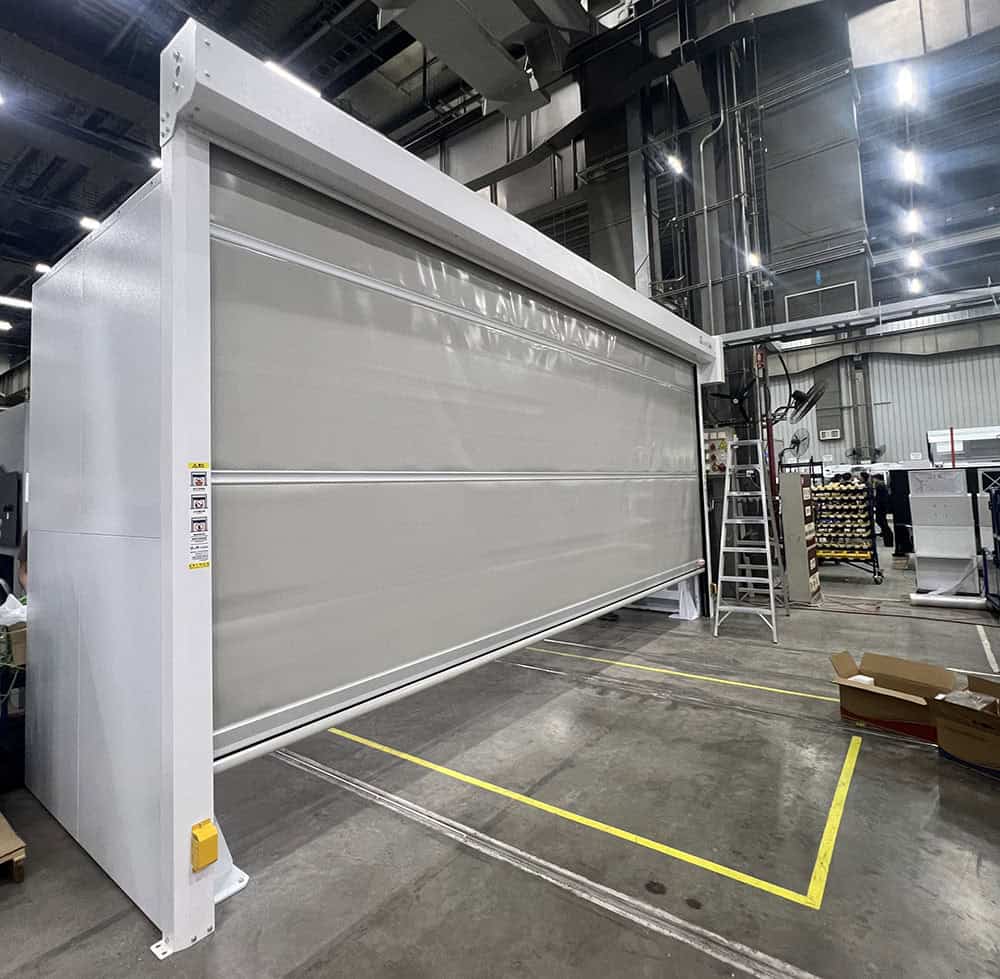
SEPPES supplied one machine safety roll up door sample for AI vision and optical micro/nano inspection equipment. The compact flexible door creates a movable access barrier at the equipment opening while supporting the machine’s planned loading, inspection, and operator-access sequence.
The sample included manual push buttons on both sides and a safety photocell. Its purpose was to let the equipment manufacturer evaluate the mechanical fit and basic door functions before defining any wider production rollout or automation interface.
Project Snapshot
| Project item | Confirmed detail |
|---|---|
| Application | AI vision and optical micro/nano inspection equipment |
| Supply stage | One sample door |
| Door type | Machine safety roll-up door |
| Basic activation | Manual push buttons on both sides |
| Safety device | Safety photocell |
| Confirmed dimensions | Not published; must be engineered for the machine opening |
| Future integration | Optional and subject to controls engineering |
Why Use a fast action roller doors on Automated Equipment?
Automated inspection equipment may need a temporary physical boundary during part of its operating sequence, followed by clear access for loading, transfer, adjustment, or service. A vertically moving flexible door occupies little floor space and keeps the access path clear when open.
Compared with a hinged guard, a industrial rollup doors format avoids a swinging leaf around the machine. Compared with a fixed guard, it can support controlled material or operator access where the process requires repeated opening. The final choice depends on risk assessment, required separation, machine cycle, stopping time, and the hazards behind the opening.
The US Occupational Safety and Health Administration describes general machine-guarding requirements . A door is only one component of a safeguarded machine. It does not by itself make equipment compliant or safe.
Confirmed Sample-Door Functions
- Push Buttons on Both Sides
Manual controls on each side let the equipment team test opening and closing during sample evaluation. Button position should preserve visibility of the access zone and prevent unintended operation.
For a production machine, button behavior must be documented: momentary or maintained command, permitted machine state, opening priority, closing request, emergency behavior, and reset procedure.
- Safety Photocell
The sample included a photocell to detect an obstruction in its beam. If the beam is interrupted, the controller follows the configured protective response.
A single photocell may not detect every body position, object, or approach. The required protective field and performance level must come from the machine risk assessment. Depending on the hazard, the system may need a light curtain, safety edge, guard locking, safe-speed function, scanner, or other protective devices.
- Compact Vertical Movement
The flexible curtain travels vertically, helping the door fit close to equipment where floor space is limited. Actual headroom, guide placement, maintenance clearance, and curtain material must be confirmed from the equipment design.
Machine Protection Doors and Control Interlocking
In a future automated configuration, machine protection doors can exchange signals with the machine controller. A typical engineered sequence might be:
1. The machine requests the door to close.
2. The door completes its movement and returns a verified closed-state signal.
3. The machine safety system determines whether the process is allowed to start.
4. At the end of the safe machine state, the controller permits an opening request.
This is an example of possible logic, not a claim about the current sample. The project confirmed only the two-sided manual push buttons and safety photocell.
Dry contacts, RS485, PROFINET, or EtherNet/IP may be considered for a later engineered version. Protocol availability does not establish a safety function. Safety-rated architecture, diagnostics, validation, and responsibility boundaries must be defined by qualified machine and controls engineers.
See a related [SEPPES robot-arm interlocked industrial door application and the broader [high speed door range].
What the Sample Evaluation Should Verify
Mechanical Fit
Confirm the clear opening, overall envelope, moving components, mounting points, access panels, cable routes, and service clearance. The current page does not publish confirmed dimensions, so no size should be inferred.
Operating Sequence
Test how the quick acting industrial doors behaves during loading, inspection, unloading, adjustment, cleaning, and fault recovery. Identify which steps require the door to be open, closed, or prevented from moving.
Stopping and Hazard Time
The machine risk assessment should compare door movement, machine stopping time, approach speed, and distance to the hazard. A closed-door feedback signal alone is not proof that hazardous motion has stopped.
### Fault Response
Define the response to sensor interruption, door fault, communication loss, power loss, emergency stop, and manual release. Restart should require the intended checks and should not occur unexpectedly when the obstruction is cleared.
Durability and Maintenance
Review expected cycles, curtain exposure, contamination, cleaning method, inspection interval, spare parts, and safe maintenance access. Sample testing should represent the planned production environment as closely as practical.
Machine Door vs. Complete Safety System
| Component | Role |
|---|---|
| Machine safety roll up door | Movable physical boundary at the opening |
| Door photocell | Detects interruption within its defined beam |
| Machine safety controller | Evaluates safety inputs and commands the safe response |
| Hazard-control devices | Stop, isolate, limit, or contain the identified hazard |
| Risk assessment and validation | Establish and verify that the complete system reduces risk as intended |
The door should be selected and validated within this complete architecture. Neither fast movement nor a safety sensor removes the need for machine-level engineering.
