
Commercial High Cycle Doors for a SCHNEEBERGER Workshop Upgrade
SCHNEEBERGER selected rigid commercial high cycle doors as part of a multi-stage workshop entrance upgrade. The customer had used flexible PVC fast doors but wanted a more refined metal-panel appearance while retaining rapid daily access.
After a supplier audit and factory visit, the project progressed through four contracts. The completed scope included seven aluminum spiral high speed door and three industrial sectional doors, for a total of ten doors. One reference opening measured W4500 × H3000 mm.
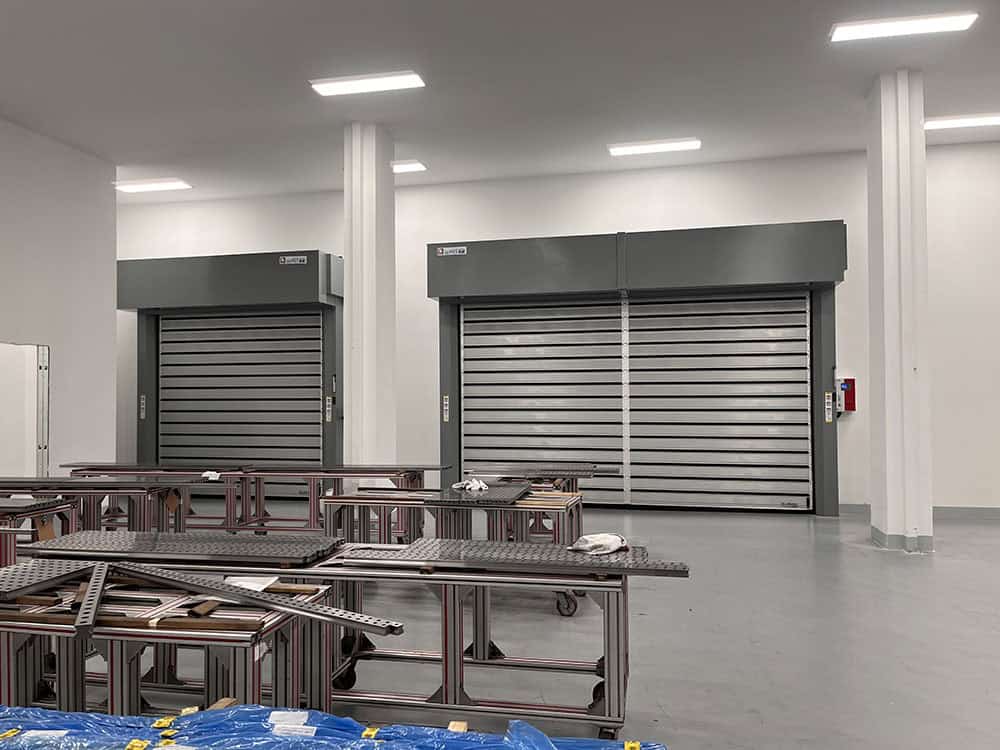
Podsumowanie projektu
| Element projektu | Potwierdzony szczegół |
|---|---|
| Klient | SCHNEEBERGER |
| Zastosowanie | Production workshop entrance upgrade |
| Procurement process | Supplier audit and factory visit |
| Contract history | Four contracts |
| Total quantity | Ten doors |
| Rigid high-speed doors | Seven |
| 工业分段门 | Three |
| Reference size | W4500 × H3000 mm |
| Aktywacja | Radar detekcji pieszych i pojazdów |
| Access interface | Customer access-control system |
Why Replace Flexible PVC Doors with a Rigid Solution?
The existing PVC doors provided fast movement, but the workshop upgrade placed greater emphasis on the visual quality and solid feel of the entrances. A high speed spiral garage door uses interlocking rigid slats that travel through a spiral or track arrangement above the opening. The result combines fast movement with a durable metal-panel appearance.
Rigid high-speed construction can also offer better resistance to routine contact and environmental exposure than a lightweight flexible curtain, depending on the selected panel, guides, and finish. It should not be described as impact-proof. Vehicle separation, warning devices, safe operating logic, and driver behavior remain essential.
The UK Health and Safety Executive recommends separating pedestrians and vehicles in workplace transport wherever practical. Door automation should support that traffic plan, not replace it.
What “High Cycle” Means for This Project?
Commercial high cycle doors are designed for entrances that operate much more frequently than conventional doors in the same facility. Rapid opening can reduce waiting at the threshold, while controlled closing helps restore the workshop boundary after each passage.
No universal cycle count should be assumed from the phrase “high cycle.” Duty suitability depends on door size, speed, motor and control selection, hourly peaks, total daily movements, temperature, wind exposure, maintenance, and the time available between cycles. These details should be supplied before engineering review.
Coordinating Two Door Types Across One Workshop
The customer did not use one door type for every opening. Seven passages received spiral high speed door, while three received sectional doors. This mixed configuration matched each doorway to its traffic and building function.
| Selection factor | Rigid high-speed door | Przemysłowe drzwi segmentowe |
|---|---|---|
| Primary role in this project | Frequent workshop access with a refined rigid appearance | Lower-frequency or function-specific building openings |
| Movement | Fast vertical operation | Conventional sectional movement |
| Door leaf | Rigid interlocking slats | Insulated sectional panels |
| Typical decision driver | Cycle frequency, traffic flow, and presentation | Insulation, opening geometry, and practical building closure |
Pedestrian-Vehicle Detection Radar
The installed radar distinguishes between pedestrian and vehicle movement so the control system can apply the configured response. This can reduce unnecessary full opening for pedestrian traffic and support a more orderly entrance sequence.
Radar performance depends on mounting position, detection field, approach speed, surrounding movement, and commissioning. Safety photocells, light curtains, warning lights, or separate pedestrian routes may still be needed. Detection should be tested using the real people and vehicles expected at the site.
Access-Control Integration
The high speed spiral door interface with the customer’s access-control system. An authorized signal can request opening, while the door controller manages the operating and safety sequence.
Before installation, both parties should define:
– The type and duration of the opening signal.
– Authorization rules for people, vehicles, and work shifts.
– Sygnały zwrotne, takie jak otwarte, zamknięte, w ruchu lub awaria.
– Zachowanie po przerwie w zasilaniu lub utracie komunikacji.
– Procedury otwierania awaryjnego i obsługi ręcznej.
– Odpowiedzialność za kable, zaciski, testowanie i odbiór końcowy.
Kontrola dostępu nie zastępuje niezależnych urządzeń bezpieczeństwa bramy. Ostateczny interfejs powinien być udokumentowany i uruchomiony jako kompletny system.
Dlaczego projekt rozszerzył się na cztery umowy
Klient zweryfikował dostawcę i zdolności produkcyjne przed kontynuowaniem. Udana dostawa doprowadziła następnie do wielu zamówień, a nie pojedynczej jednorazowej instalacji. Ostateczna ilość—siedem sztywnych bram szybkobieżnych i trzy bramy segmentowe—odzwierciedla potwierdzoną historię projektu.
Ten przypadek pokazuje wartość standaryzacji wymagań dotyczących sterowania i serwisu w całym warsztacie, przy jednoczesnym wyborze odpowiedniej bramy fizycznej dla każdego otworu. Standaryzacja może uprościć szkolenie operatorów i konserwację, ale nie powinna być nadrzędna wobec lokalnych warunków ruchu lub konstrukcyjnych.
